Nine Days in a Swaying Box: The Journey That Made San Francisco Feel Like Another Planet
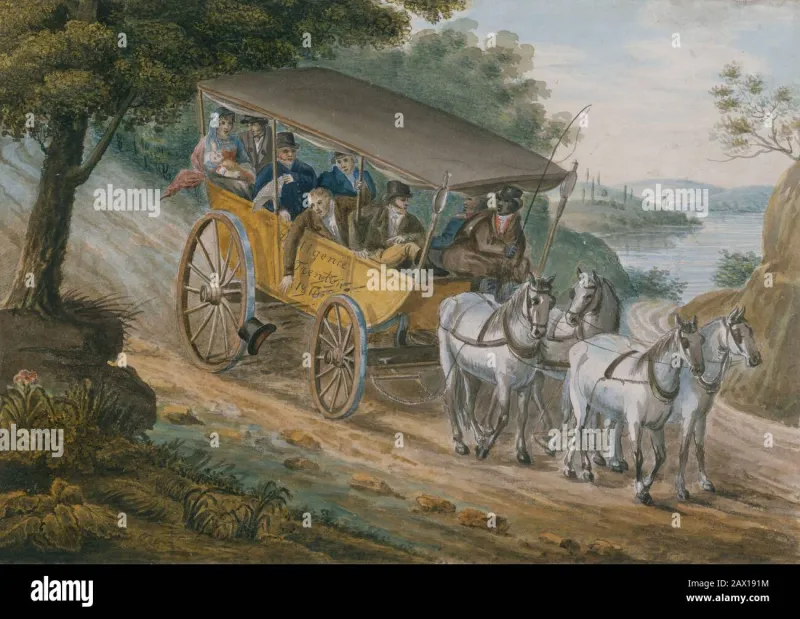
Photo: vintage stagecoach traveling across American prairie 1800s, via c8.alamy.com
Picture this: you want to visit a relative in California. Before you go, you update your will, say your goodbyes at church, and pack enough food for a month. That's not a dramatic exaggeration — that's simply what a cross-country trip required in the middle of the 19th century.
For most of American history, the distance between the Atlantic and the Pacific wasn't measured in miles. It was measured in endurance.
When the Map Was Mostly a Guess
In the 1840s, there was no railroad west of the Mississippi. No highway. No reliable road of any kind through much of the continent. A traveler heading from New York to San Francisco had exactly two options, and neither was pleasant.
The overland route meant wagons and stagecoaches grinding through prairie, desert, and mountain passes. The journey took four to six months in a wagon train, and even the fastest stagecoach express services needed around three weeks of near-continuous travel. Passengers slept — badly — in a swaying coach, ate whatever the next station provided, and faced everything from broken axles to bandits.
The other option was the long way around: a steamship to Panama, a mule-and-canoe crossing through the jungle of the isthmus, then another ship up the Pacific coast. The jungle crossing alone could take a week and often meant malaria with your meals. In 1849, a New York to San Francisco trip by this route cost roughly $500 to $1,000 — at a time when a skilled worker might earn a dollar a day. A one-way trip could consume a year's wages.
And here's a detail worth savoring: stagecoach companies had weight limits. Passengers were allowed a small trunk, and their actual luggage was frequently left behind, sold, or simply lost. The suitcase that outweighed the person carrying it is a modern absurdity. Back then, you were lucky to bring anything at all.
The Iron Horse Shrinks the Continent
On May 10, 1869, workers drove a golden spike at Promontory Summit, Utah, and the two coasts were finally connected by rail. The change was so sudden and so complete that it's hard to overstate.
A journey that had taken months now took about a week. By the 1880s, the fastest express trains were doing it in under four days. And for the first time, ordinary families — not just the wealthy or the desperate — could consider moving to or visiting the West Coast.
The railroads also invented a small miracle that changed travel forever: the Pullman sleeping car. George Pullman's rolling hotel rooms meant you could board in Chicago, eat a hot meal in a dining car with white tablecloths, sleep in an actual bed, and wake up rolling through the Rockies. For a generation raised on wagon trails, this was science fiction made of wood and steel.
But even the great trains had limits. The 1881 express from coast to coast took 90 hours, and that was a record. A single delay — snow in the Sierras, a washed-out bridge in Nebraska — could add days.
Lincoln Highway to Jet Age
Then came the automobile. The Lincoln Highway, dedicated in 1913 as America's first coast-to-coast road, turned the trip into a two- to three-week adventure — often on dirt tracks that dissolved into mud. Families drove it as a trial of character. Many didn't finish.
The interstate highway system of the 1950s brought the drive down to a manageable five days. Impressive, but still a vacation in itself.
Then the jet engine arrived. By 1959, commercial jets were crossing the country in under five hours. Today's nonstop flight from New York to San Francisco clocks in at around six hours — less time than a single layover in 19th-century Panama, where you might wait days for a ship that may or may not show up.
What We Gained, What We Forgot
There's a case to be made that something was lost in all this speed. The 19th-century traveler arrived in San Francisco knowing they had crossed a continent — every mile paid for in discomfort. We arrive with sore knees and complaints about the pretzels.
But consider what the speed actually bought us. A country that once had two coasts, culturally speaking, now has one connected society. Families spread across 3,000 miles can visit for a weekend. Business, disaster response, even friendship all operate at a pace that would have seemed like magic to the stagecoach passenger.
The next time your flight is delayed by 45 minutes, it might help to remember: your great-great-grandparents budgeted half a year for the same trip, and half of them never made it back. The delay is annoying. The transformation is remarkable.