The Man with the Lasting Machine — When American Shoes Were Built to Be Rebuilt
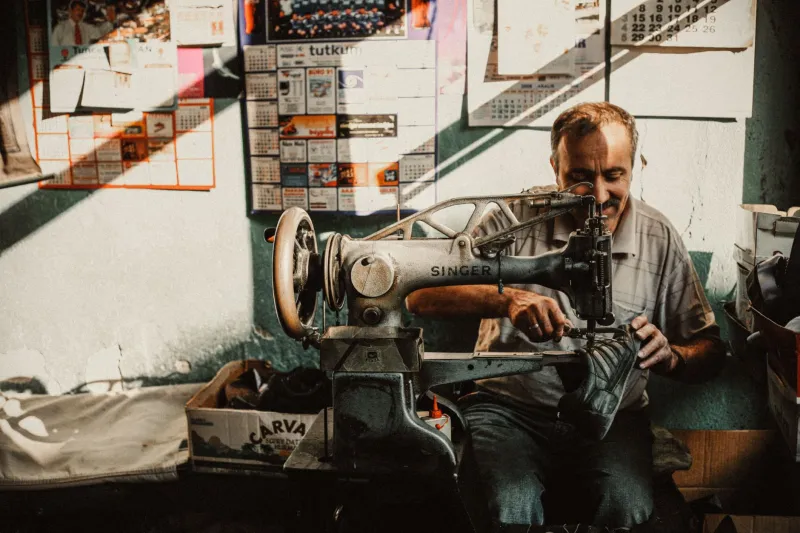
In the back of a narrow shop on almost any American commercial block, sometime between 1930 and 1975, you would have found roughly the same scene: a man bent over a cast-iron last, a curved piece of equipment shaped like a foot, with a half-finished shoe clamped to it. The smell of leather and adhesive and rubber and something vaguely chemical hung in the air. A mechanical stitcher sat to one side. Finished shoes hung in pairs from hooks along one wall, each with a small paper tag bearing a customer's name.
The cobbler. The shoe repairman. The person your grandfather called without thinking, the way you call a rideshare without thinking — automatically, because there was simply no other sensible option.
A Trade Older Than the Republic
Shoe repair is one of the oldest skilled trades in human history, and in America it arrived with the first waves of European immigration. By the early twentieth century, nearly every town of any size had at least one cobbler, and larger cities had dozens. Many were Italian or Eastern European immigrants who had learned the trade in the old country and brought their tools and their knowledge with them.
The equipment was specialized and expensive: lasting pliers, welt irons, sole stitchers, heel nailing machines, finishing wheels. A cobbler's shop represented a significant capital investment, and the knowledge required to use the equipment properly took years to develop. This was not a trade you picked up in an afternoon.
But the economics made sense, because the shoes being brought in were worth repairing. A good pair of leather dress shoes in the 1950s represented a meaningful portion of a working man's weekly wage. You didn't discard them because the heel wore down. You took them to the cobbler, paid a fraction of the replacement cost, and walked out with another year or two of service.
What the Cobbler Actually Did
The range of work a skilled shoe repairman could perform was considerably broader than most people today realize. Resoling — replacing the entire bottom surface of a shoe — was the most common job, but it was far from the only one.
Heels were rebuilt or replaced. Leather uppers were cleaned, conditioned, and stitched where they had cracked or separated. Insoles were replaced when they compressed flat. Zippers on boots were swapped out. Stretched leather was reshaped on lasts. Dye was applied to restore faded color. A truly skilled cobbler could take a shoe that looked finished and return it looking — and more importantly, fitting — almost like new.
Good cobblers also knew their customers' feet. A man who had been bringing his shoes to the same shop for fifteen years had a file, even if it was just a mental one. The cobbler knew that this customer's right heel wore faster than his left, that he needed extra cushioning at the ball of the foot, that he was hard on the outside edge of his soles. This knowledge was applied automatically, without being asked.
The Neighborhood Anchor
Like the barber and the pharmacist, the cobbler occupied a particular social role that went beyond the technical service being provided. The shop was a place where you dropped something off and returned for it — which meant two visits, and two conversations, for every transaction.
In tight urban neighborhoods, the cobbler's shop was often a kind of informal community center. Men would stop in not because they had anything to drop off but because the shop was on the way somewhere else and the conversation was worth a few minutes. The cobbler, rooted to his bench and his neighborhood in ways that white-collar workers rarely were, accumulated a remarkable amount of local knowledge over decades of operation.
Many shops were genuinely multigenerational. A cobbler who opened his shop in 1935 might still be there in 1970, having repaired shoes for the same families across three decades. His son might be working the bench beside him. The continuity was part of the value.
The Quiet Collapse
The throwaway economy didn't arrive with a single announcement. It crept in through a series of small economic shifts, each one individually reasonable, that together dismantled the conditions that had made shoe repair viable.
The first shift was manufacturing. Post-war industrial production made shoes cheaper to produce, which made them cheaper to buy, which subtly changed the calculation around repair. If a new pair cost only slightly more than resoling the old pair, the math started to tilt toward replacement.
The second shift was materials. As synthetic soles replaced leather, as injection-molded construction replaced hand-stitching, shoes became structurally harder to repair. A cemented sole can be replaced once, maybe twice. A heat-bonded synthetic construction may not be repairable at all without specialized equipment that most cobblers don't carry.
The third shift was culture. By the 1980s and 1990s, athletic shoes had become the dominant casual footwear in America. Sneakers, by design and by price point, were not meant to be resoled. They were meant to be worn until they weren't and then replaced. A generation grew up not knowing that shoe repair was even an option.
By the early 2000s, the number of shoe repair shops in the United States had dropped by more than half from its mid-century peak. The Bureau of Labor Statistics eventually stopped tracking cobblers as a distinct occupational category.
What Was Really Being Discarded
The cobbler's disappearance is, on one level, a simple story about economic disruption — a trade made obsolete by cheaper manufacturing and changing consumer habits. But it also marks something more fundamental about how American culture's relationship with objects shifted.
A shoe that could be resoled was a shoe designed to last. It was made of materials durable enough to survive the repair process — full-grain leather, a Goodyear-welted construction that allowed the sole to be separated cleanly from the upper. Building a shoe that way cost more. But it also meant the shoe was a long-term companion rather than a seasonal purchase.
The cobbler didn't just extend the life of footwear. He was the human embodiment of a value system that treated quality as an investment, repair as responsible, and disposal as a last resort rather than a first impulse.
That value system didn't disappear entirely. High-end shoe brands still make resoleable footwear. A small revival of craft cobbling has emerged in certain cities, serving customers willing to pay for quality and longevity. But these are niche markets, not the mainstream.
For most American consumers, a shoe is now a seasonal object with a built-in expiration date. The man with the lasting machine would find that very hard to understand.