Nobody Left the Table Until Dad Said So — The Lost Rules of the American Family Dinner
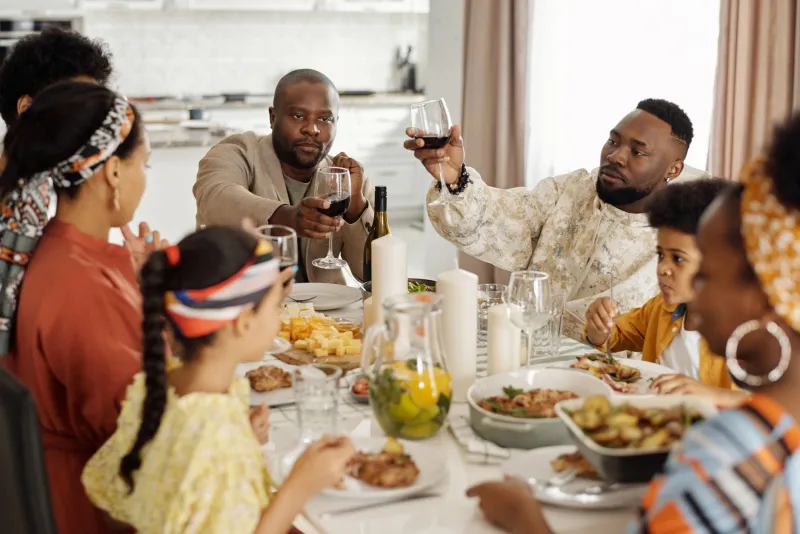
Somewhere between the postwar American suburb and the smartphone, the family dinner stopped being mandatory.
It didn't happen all at once. There was no single moment when Americans collectively decided that eating together every night was optional, inconvenient, or just not worth the effort. It was a slow unraveling — pulled apart by longer commutes, later work hours, after-school activities, television schedules, and eventually the glowing screens that made eating alone feel less lonely than it used to.
But for most of the twentieth century, the dinner table was an institution. And institutions, it turns out, carry a lot of invisible weight.
The Table Had Rules You Didn't Question
In the 1950s and 1960s, the evening meal in most American homes operated on a set of expectations so consistent they barely needed to be stated. Dinner was at a fixed time — six o'clock, or six-thirty, and you were expected to be there. You washed your hands. You sat in your assigned seat. You didn't start eating until everyone was served. You asked to be excused.
These weren't just table manners. They were a daily exercise in family hierarchy, shared attention, and the idea that some things took precedence over individual preference. A child who had plans at dinnertime didn't have plans at dinnertime. The table came first.
Conversation followed its own structure too. Kids reported on school. Parents discussed the day. There was an implicit understanding that this was information exchange — that you were supposed to know what was happening in each other's lives, and the dinner table was where that knowledge got updated. Family therapists have noted for decades that shared meals are among the most reliable predictors of adolescent wellbeing, in part because they create a daily check-in that's hard to replicate any other way.
What Pulled the Table Apart
The unraveling began earlier than most people realize. Television was the first serious competitor. By the late 1950s, the TV dinner had given American families permission to eat in front of the set, and the logic of the living room started competing with the logic of the kitchen table.
But the bigger disruptions came later, and they were structural rather than cultural. As women entered the workforce in larger numbers through the 1970s and 1980s, the person who had traditionally organized and prepared the evening meal was no longer home at four in the afternoon. Dinner got later. It got simpler. Sometimes it got skipped.
The rise of suburban car culture meant that family members were increasingly scattered across different schedules. A daughter with soccer practice at six. A son with a part-time job until seven. A father commuting ninety minutes each way. The logistics of getting everyone to the same place at the same time stopped being automatic and started requiring genuine coordination.
Fast food accelerated the fragmentation. When a drive-through could produce dinner in four minutes, the calculus shifted. Why cook a full meal for a family that couldn't all make it to the table anyway?
The Screen in the Room That Changed Everything
The smartphone, arriving in earnest around 2007, didn't create fractured family eating — it inherited a pattern already well established. But it did something important: it made eating alone feel socially normal in a way it hadn't before. You were never truly alone if you had a screen. You were always, in some sense, at a table with someone.
For teenagers especially, the pull of peers via text and social media made the family dinner feel like an interruption rather than an anchor. Research from the National Center on Addiction and Substance Abuse at Columbia University found in the mid-2000s that teens who ate dinner with their families five or more times a week were significantly less likely to use drugs, smoke, or drink — not because dinner had magic properties, but because it maintained connection and oversight in a way that nothing else quite replicated.
What Actually Got Lost
It's tempting to romanticize the mandatory family dinner — to forget the tension, the lectures, the silences, the meals that felt more like performance reviews than shared experiences. Not every family table was warm. Not every conversation was healthy. For some kids, dinner was the most stressful hour of the day.
But the institution carried things that are harder to replace than the meal itself. Conflict got aired and sometimes resolved. Kids watched adults disagree and work through it. Grandparents passed down stories that nobody asked for but everyone absorbed. The table was a place where you had to be present — not performing, not curating, just there — in a way that modern life rarely demands.
According to a 2023 survey by the Food Marketing Institute, fewer than thirty percent of American families eat dinner together on any given weeknight. That's a remarkable shift from the mid-twentieth century norm, when shared evening meals were close to universal among two-parent households.
The Meal That Became a Special Occasion
Here's the quiet irony: the family dinner didn't disappear so much as it got elevated. Because it's no longer automatic, it's become intentional — something families plan for, celebrate, and Instagram. Sunday dinner. Holiday meals. The birthday dinner out.
When something stops being ordinary, it becomes meaningful in a different way. Whether that trade-off is worth it — the daily ritual exchanged for the occasional event — is a question every family is answering differently, and mostly without realizing they made the choice at all.