Medicine's Line in the Sand: The Year Doctors Admitted They Had No Answers
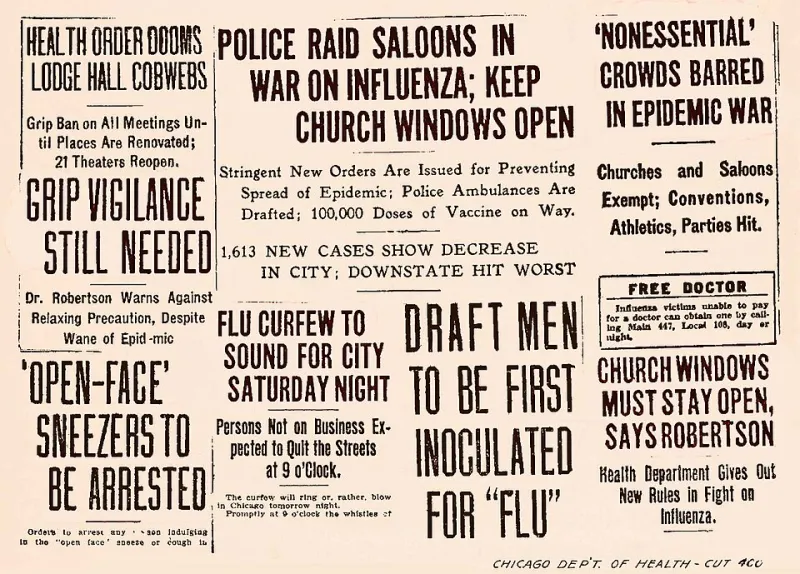
Photo: Various newspapers in Chicago, Illinois, U.S., in 1918, Public domain, via Wikimedia Commons
Here's an uncomfortable thought experiment: imagine the most capable doctor in your town today being struck of uselessness. Not lazy, not corrupt — simply without tools. That was American medicine in 1917, and it took the worst pandemic in modern history to force the profession to admit it.
We tend to assume healthcare was always what it is now: imaging machines, emergency rooms, vaccines on a schedule. In reality, the confident, science-driven medicine we take for granted is younger than sliced bread. And 1918 is the year the old world visibly failed.
What Doctoring Actually Looked Like
Before the pandemic, the typical American's medical care was a strange blend of folklore and improvisation. Doctors traveled by horse and buggy — the automobile only started replacing it around 1910, and rural physicians kept horses into the 1930s. They carried a black bag containing a stethoscope, maybe a thermometer, and not much else.
There were no antibiotics. Penicillin wouldn't reach patients until the 1940s. There were no ICU beds, no ventilators, no antivirals. A bacterial pneumonia — the thing that actually killed most 1918 flu victims — was treated with what little doctors had: mustard plasters, quinine, whiskey, and hope.
Hospitals existed, but they were places the poor went to die. Middle-class families expected care at home, delivered by a doctor who often knew your family across generations. Quarantine was enforced by rumor and a card nailed to the front door, not by contact tracing or public health databases.
And crucially, the profession itself was only recently scientific. The Flexner Report of 1910 had just begun shutting down the diploma mills and folk-medicine schools that had licensed most American doctors. In 1918, many practicing physicians had been trained in institutions that taught almost no laboratory science at all.
The Reckoning
The influenza pandemic of 1918–1919 infected roughly a third of humanity and killed an estimated 675,000 Americans — more than the Civil War, more than World War I, which was happening at the same time. Philadelphia ran out of coffins. Chicago passed emergency ordinances about coughing in public. Schools and churches closed in city after city.
Medicine's response, honestly assessed, was close to helpless. Doctors tried everything and achieved little. Vaccines developed during the pandemic targeted the wrong organism entirely, because scientists didn't yet know a virus caused the flu — the influenza virus wasn't even isolated until 1933.
That helplessness was the point. The pandemic was medicine's public humiliation, witnessed by an entire generation. And professions, like people, tend to change after humiliation.
What the Failure Built
The decades that followed represent the most dramatic transformation in the history of the healing arts. Sulfa drugs arrived in the 1930s. Penicillin went mass-scale during World War II. The flu virus was identified, and an approved flu vaccine followed by 1945. The polio vaccine came in 1955, and within a generation, one of childhood's greatest terrors was essentially gone.
Public health went from a rumor-driven scramble to a coordinated federal system — the CDC was founded in 1946, growing directly out of wartime disease-fighting experience. Life expectancy in the US, roughly 39 years in 1900, climbed past 70 by century's end. Nearly all of that gain came from exactly the kind of infectious-disease control that failed so completely in 1918.
Why This Should Make Us Humble — and Grateful
My argument is simply this: our confidence in medicine is not natural, and it is not old. It was purchased, in a single terrible year, by a profession forced to admit it knew nothing.
That's worth remembering in 2020's aftermath, when faith in health institutions took its own beating. The system that guided us through COVID — genome sequencing in days, vaccines in under a year, real-time global data — was built by people who lived through 1918 and swore it would never happen blind again.
The line between the old world and the new runs straight through that pandemic. We live on the far side of it. The very fact that we expect medicine to have answers is, historically speaking, the most remarkable change of all.