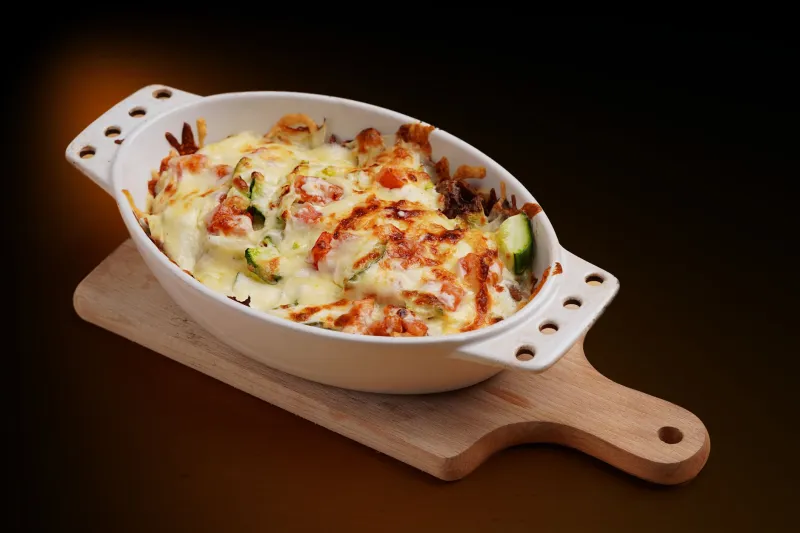
Open a can. Add a protein. Mix in some frozen vegetables, top with crushed crackers, and slide the whole thing into a 350-degree oven. For a significant stretch of American history, this wasn't cutting corners. This was cooking.
The casserole — specifically the cream-of-mushroom-soup casserole — was, for a generation of American families, a genuine expression of modernity. And understanding why tells you a lot about how dramatically our relationship with food has shifted.
The Can as a Symbol of Progress
To understand mid-century America's love affair with canned and processed food, you have to understand what came before it. Cooking in the early twentieth century was exhausting, time-consuming labor. Women spent hours each day sourcing ingredients, preserving food, and preparing meals from scratch. There were no shortcuts. There was no margin.
When industrial food processing expanded after World War II, it genuinely changed lives. Canned goods meant less time at the stove. Frozen vegetables meant no more seasonal limitations. Cream of mushroom soup, introduced by Campbell's in 1934 but embraced by postwar home cooks with extraordinary enthusiasm, became a culinary Swiss Army knife — a ready-made sauce, a binder, a flavor base, all in one compact can.
This wasn't laziness. This was liberation.
Magazines like Good Housekeeping and Better Homes and Gardens ran recipes that leaned heavily on canned and processed ingredients, presenting them not as compromises but as achievements. The modern housewife wasn't someone who spent all day hunched over a hot stove. She was someone smart enough to use the tools available to her. Convenience food was aspirational.
The TV Dinner and the Promise of Leisure
Nothing captured this spirit quite like the TV dinner. When Swanson introduced its frozen meal in 1953, it wasn't marketed as a sad substitute for real cooking. It was marketed as a ticket to the future. You could eat a complete meal while watching television. You didn't have to choose between feeding your family and enjoying your evening.
Sales figures reflected the enthusiasm. Swanson sold ten million units in the first year. Competitors flooded the market. The aluminum tray with its segmented compartments became a cultural icon — shorthand for a new kind of American life where technology did more of the heavy lifting.
And it wasn't just about convenience. Processed foods carried genuine status. Having a kitchen stocked with brand-name canned goods and frozen products signaled that your family was modern, that you had moved beyond the drudgery of subsistence cooking. It was the same impulse that made people proud to own a dishwasher or a refrigerator with an automatic ice maker.
When the Story Changed
Somewhere in the 1970s and 1980s, the narrative began to shift. The natural food movement, early warnings about sodium and preservatives, and a growing cultural interest in authentic ingredients started to complicate the convenience food story. By the time the farm-to-table movement took hold in the 2000s, the transformation was nearly complete.
The same cream-of-mushroom casserole that once signaled a liberated, forward-thinking homemaker now signaled — to a certain kind of food-conscious consumer, at least — poor nutritional judgment. Processed food went from being a symbol of progress to a marker of either poverty or ignorance, depending on who was doing the judging.
This is a remarkable reversal. The same object, carrying almost opposite cultural meaning within a single lifetime.
The Guilt That Replaced the Pride
Today, the food landscape is almost comically fragmented. On one end, you have the farmer's market devotees, the sourdough bakers, the people who know the name of the farm where their chicken was raised. On the other, you have a food industry that still sells billions of dollars worth of processed and convenience products every year — because most American families still need shortcuts, still have limited time, still face the same pressures that made those canned goods so appealing in 1955.
The difference is the guilt. The mid-century housewife who served a tuna noodle casserole felt proud of herself. Many people who reach for a can today feel like they're failing at something. Food culture has developed an elaborate moral vocabulary — clean eating, whole foods, real ingredients — that frames processed food not just as a nutritional choice but as a character flaw.
Whether that shift represents genuine progress or just a new kind of snobbery is genuinely complicated. The science around ultra-processed foods is concerning and worth taking seriously. But the cultural weight we've placed on what people eat — and the judgment directed at those who can't afford or don't have time for the farmer's market version of dinner — is something else entirely.
What the Casserole Actually Was
Here's what gets lost in the current conversation: those mid-century recipes worked. People ate them, gathered around tables, fed their kids, and got on with their lives. The green bean casserole that's still served at Thanksgiving tables across the country every November isn't there because it's nutritionally optimal. It's there because it connects people to something — a grandmother's kitchen, a specific memory, a particular kind of warmth.
Convenience food didn't destroy American cooking. It changed it, the way every generation of technology changes the things it touches. The question worth asking isn't whether a casserole made with canned soup is better or worse than a dish assembled from scratch ingredients. It's why we've become so invested in the answer.
The can opener was once a symbol of the future. That future arrived, stayed for a while, and got rebranded as the past. The casserole is still in the oven. We're just not sure how to feel about it anymore.