When Flying Was an Event — And Economy Class Didn't Exist Yet
When Flying Was an Event — And Economy Class Didn't Exist Yet
There's a particular kind of misery that comes with a modern flight. The middle seat. The $14 airport sandwich you're eating because the airline charges extra for a snack box. The knees pressed firmly into the seat in front of you. It's so familiar it barely registers anymore.
But it wasn't always this way. There was a time — not ancient history, just a few decades back — when stepping onto a commercial aircraft was genuinely exciting. When passengers dressed up. When the food was cooked, not reheated. When the whole experience felt less like a bus with wings and more like a night out.
That era is gone. And the gap between what flying used to be and what it is today is wider than most people realize.
The Velvet Rope Above the Clouds
In the 1950s, commercial aviation was still young enough to feel like a miracle. Pan American World Airways, TWA, and American Airlines competed not just on routes, but on elegance. Flying was expensive — a round-trip ticket from New York to Los Angeles in 1955 cost roughly $220, which adjusts to somewhere north of $2,500 in today's money. That price tag meant the passenger cabin was, by default, a wealthy crowd.
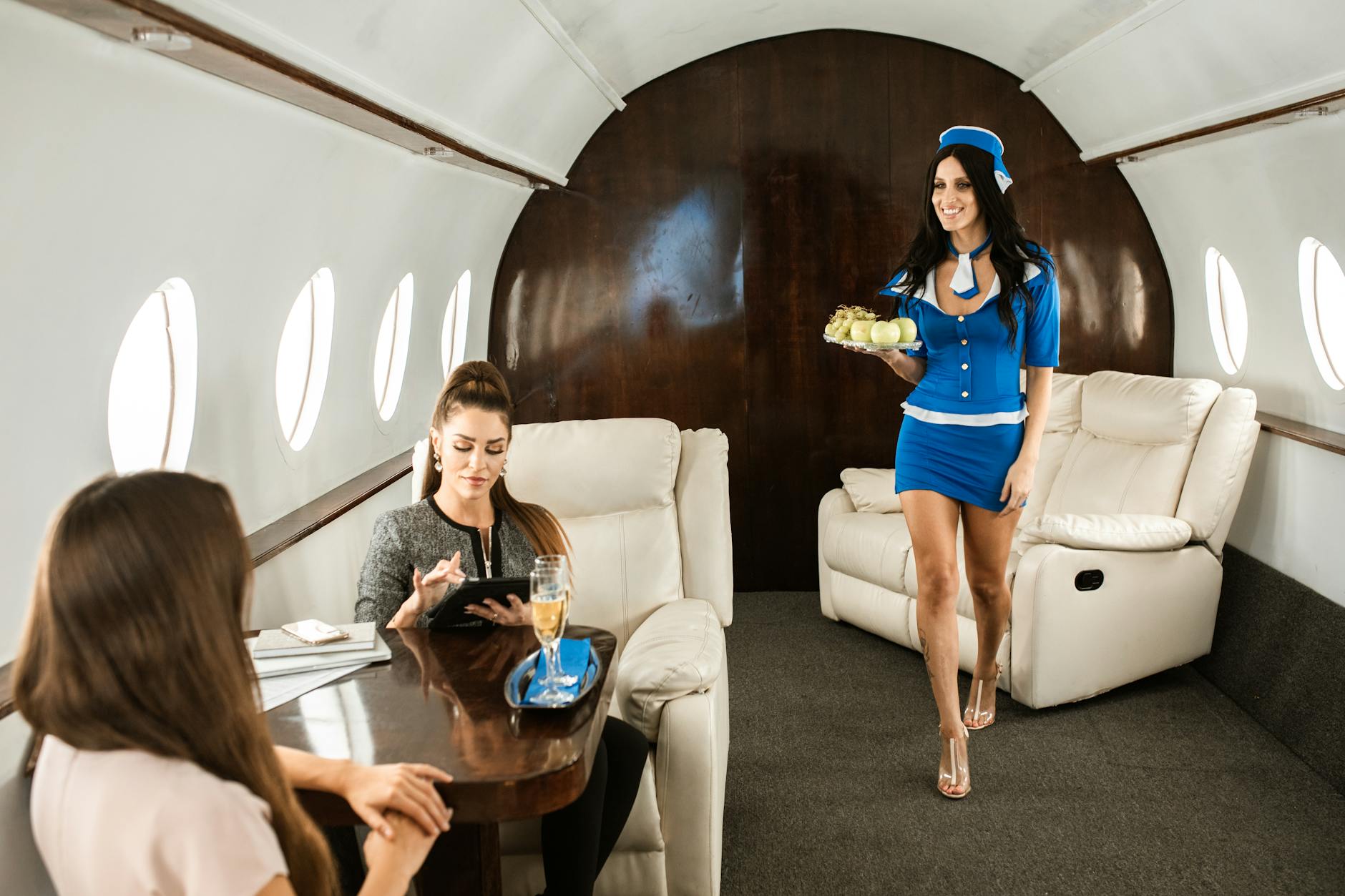
And airlines dressed the experience to match. Seats in the main cabin were wide — sometimes more than 20 inches across, with legroom (or "seat pitch," in industry terms) stretching to around 34–36 inches. First class on long-haul routes offered sleeper berths and lounge areas. Flight attendants — then called stewardesses, and required by most airlines to be unmarried women under a certain age, a discriminatory standard that would thankfully be dismantled in later decades — served multi-course meals on real china, with silverware and linen napkins.
The food itself was a serious affair. Menus featured carved meats, shrimp cocktails, and dessert carts. Airlines employed executive chefs. A 1960s TWA menu reads more like a mid-tier Manhattan restaurant than anything you'd associate with 30,000 feet. Passengers were offered newspapers, slippers on overnight flights, and cocktails poured freely.
Dress codes weren't posted rules so much as unspoken expectations — and nearly everyone met them. Men wore suits. Women wore dresses or tailored separates. Showing up to the gate in sweatpants would have been as unthinkable as showing up to a dinner party in them.
The Great Democratization
Something genuinely significant happened in 1978: the Airline Deregulation Act. Before that, the federal government controlled airfares and routes. Prices were fixed, competition was limited, and flying stayed expensive enough to remain a luxury. Deregulation changed all of that overnight.
New carriers flooded the market. Price wars broke out. Within a few years, average ticket prices dropped dramatically — and kept dropping. Flying became accessible to millions of Americans who had never considered it before. By the 1990s, a coast-to-coast flight could be had for a few hundred dollars. That was genuinely transformative.
But accessibility came with trade-offs that passengers didn't fully appreciate until they were already locked in.
Airlines, suddenly competing on price rather than prestige, started cutting costs wherever they could. Meal service shrank, then nearly vanished on domestic routes. Seats got narrower — today's average economy seat width hovers around 17–18 inches, down from those 1950s-era 20-plus inches. Seat pitch has compressed to as little as 28–29 inches on some budget carriers, compared to that mid-century standard of 34–36 inches. The math on that legroom difference isn't abstract — it's the difference between sitting comfortably and counting down the minutes.
The "hidden fee" era arrived in the 2000s and accelerated sharply after the 2008 financial crisis. Checked bags, seat selection, early boarding, extra legroom — things that were simply part of the ticket price for decades became separate line items. Airlines collected over $7 billion in bag fees alone in a single recent year.
What We Gained, What We Gave Up
It's worth being honest about this: the democratization of air travel is a real achievement. The idea that a teacher in Ohio or a college student in Texas can afford to fly across the country — or across an ocean — would have seemed remarkable to someone in 1955. More people seeing more of the world is a genuinely good thing.
But something else was lost in the transaction. Flying used to feel like an occasion. There was ceremony to it. You arrived at the airport with a little anticipation, not just dread. The experience itself was part of the trip.
Today, the goal for most passengers is simply to survive the flight. Get through security, find an outlet, board without incident, land without delay. The plane is a tube you tolerate, not an experience you enjoy.
Premium cabins still exist, of course — and they've actually gotten more luxurious than ever, with lie-flat beds and chef-designed tasting menus on international routes. But that world is entirely separate from what most passengers experience. The divide between the front of the plane and the back has never been wider, literally or figuratively.
A Different Kind of Arrival
There's something worth sitting with in all of this. The golden age of air travel was glamorous partly because it was exclusive — and exclusivity is nothing to romanticize uncritically. The fact that your grandmother couldn't afford to fly while a businessman in first class enjoyed a filet mignon isn't a feature worth restoring.
But the erosion of the experience itself — the shrinking seats, the nickel-and-diming, the sense that passengers are cargo to be processed rather than travelers to be welcomed — that's a different kind of loss. One that has less to do with who can afford to fly and more to do with how little the industry seems to value the experience once you're on board.
Flying changed the world. It made it smaller, faster, more connected. It just also, somewhere along the way, stopped feeling like anything at all.